

Bird Seed Bread
My Favorite Techniques for Wheat Bread
First of all, lets talk about Wheat… My favorite type of wheat to use in a bread that is 100% whole wheat, or combination of wheat and white flour is Hard Red Wheat. When I lived in the shadow of the Tetons, on the Idaho side, we would drive to St. Anthony, and get Hard Red Wheat Berries from a farmers supply there… and the Label read…. EATEN WHEAT… Grain cleaned and set aside, not for planting. Fresh ground flour, from fresh grain is a magical smell, and taste…
Now I live back in Washington State, on The Palouse, another great agriculture area of the Pacific North West. Wheat, Barley, Lentils, Garbanzos, The Local Food Systems here are amazing. Fruits, Herbs and Vegetables, Meat, Poultry, and amazing small producers and Farmers Markets. The rolling hills of the Palouse are a great place to live…
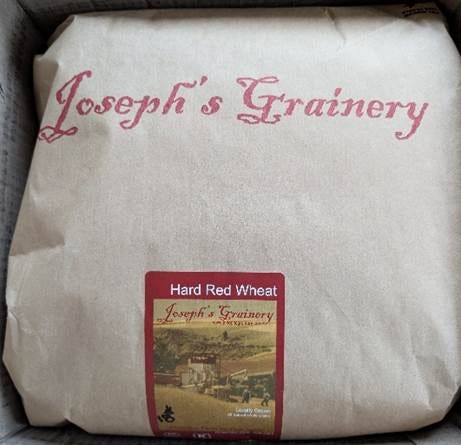
Local Hard Red Wheat Berries
I think Hard Red tastes best, and has a better “Spring” (Gluten) to it. It is hard to shift people to 100% whole wheat if they have been use to White Bread Flour. Starting with a blended bread with part whole wheat flour, and part white flour is a good idea. I will add a ½ and ½ recipe soon.
Along with 100% whole wheat, comes a few issues that make it different than baking regular bread. It absorbs more liquid than a plain flour, it can be sticky, and it just doesn’t seem to have the “Bounce” of a White bread. The techniques in this recipe below helps address these issues.
The struggle with a wheat loaf is real. It is not what most of us are used to. Will people actually eat it? What about the stomachs of those not use to 100% whole wheat. (yes, it can cause digestive upset at first) I know many people like the lighter varieties of grain grown these days, but honestly, I haven’t worked with them too much success. Montana Wheat does a great job, if you are looking for white wheat. For me, I like my wheat to be wheaty.
My past life of a baker, took me on many journeys. At one point I was delivering My Biscotti, to many states. Jackson Hole was one of the areas I delivered. This recipe comes from a long-time favorite bakery of Jackson Hole Wyoming. Their Cook Book, Called Get Your Buns in Here is listed below in the references, and if you can get your hands on one, I highly recommend it. Lots of great recipes, many with old world flavors. I had to buy another copy as the first was starting to come apart…
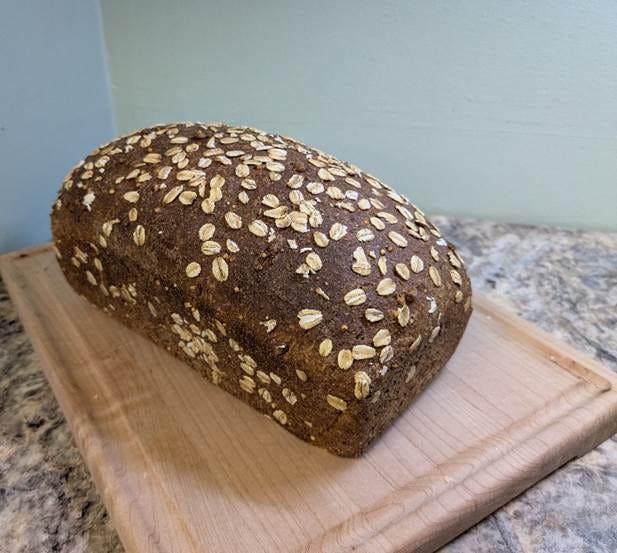
This, is my adaptation of the OSM, Oatmeal, Sunflower Seed and Millet bread, that was famous in this Jackson Hole Bakery. The Oats help with keeping the loaf moist, and helps with another issue of whole wheat bread, it tends to be dry and crumbles. This bread is excellent toasted, and great for sandwiches.
Bird Seed Bread
2 ½ cup warm water
2 ½ Tablespoon Yeast
½ cup Honey
½ cup oil
1 Tablespoon Salt
½ cup rolled Oats(+extra for rolling)
¼ cup sunflower seeds
¼ cup Millet
7 to 8 cups whole wheat flour
Makes 2 loaves
Into a large mixing bowl, measure water, add honey and mix to dissolve. Add Yeast. Let sit till bubbly on top. Add oil, and stir. Add 3 cups whole wheat flower, and beat with a wire whisk 100 times. It will look nice and glossy. Let set 20 minutes. (this is called a sponge)
Add oatmeal, sunflower seeds millet, and salt. Stir by hand to combine. Add one cup of remaining flour and stir well. Add 3 cups more remaining flour, at this point you can turn out and knead for 15 to 20 minutes, or continue in a mixer. We have 1 cup of flour remaining, and we will add this to make the dough less sticky if we need to. (Always start with less flour, and add more if needed.) the dough will be soft, but not sticky when done.
Cover dough and let rise until double. Punch down and turn onto counter and knead lightly for 5 minutes. (this helps reinvigorate the gluten)
Divide in half, and shape loaves on a lightly oiled counter,
Roll each loaf (approximately 28 oz each) shape in some extra Oatmeal, and place in a greased *1 pound loaf pan. Allow to rise, covered until double.
(I use food service, food grade, bucket liners. Place the loaves inside the bag with space so the bag doesn’t touch the dough, it keeps the moisture so the bread rises correctly)
Bake in a 350-degree oven for 40 minutes, or until the loaf sounds hallow when tapped.
A few words on Loaf pan size, and white and wheat breads. A 1 pound loaf pan, when we are making a white flour loaf, needs about 18 to 19 oz raw dough weight to come out as a 16oz , or a 1 pound loaf. Some of the moisture evaporates off in the baking process.
Whole wheat is much denser flour, and makes a heavier dough, so we need to up our raw weight to make a loaf that looks the same size as a 1 pound white loaf. We will come out with a 24 oz baked loaf of wheat bread, ( a pound and a half) so when we are scaling the dough, we will want at least 28 oz of raw dough (in a perfect world.)
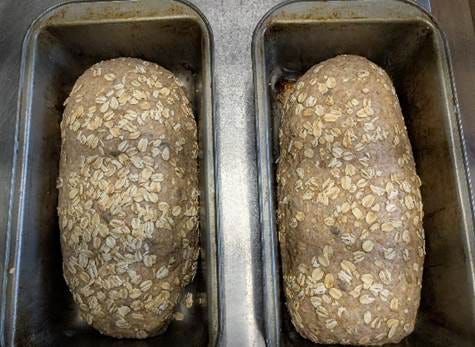
Example of 28 ounces of dough in 1 pound loaf pans prior to last rise
If we are talking then about a 1 ½ pound white loaf pan, we would need 28 ounces for a white loaf of bread, and 36 ounces for a whole wheat loaf of bread, (which will end up as 2 pounds after baking)
100% whole wheat bread, has another quirk. It does not “Push” when it hits the heat of the oven, it stays where it is. So make sure your loaf has risen to the size you want it to be. It can also deflate by just a bump at this stage, so carefully put it into the oven.
(yes, I am a bread nerd, but you, benefit from this …)
My point being, sometimes the reason you think your bread didn’t turn out right, is the amount of dough you put in a pan, not the dough itself….
So when that whole wheat flour says,-“listen kid, it’s not YOU, its ME.. “
Believe the flour, it has specific needs…
You can leave out the Oatmeal, Sunflowers Seeds, and Millet if you like, and make a straight 100% whole wheat loaf.
This bread has what seems to be a lot of extra yeast, honey, and oil. I encourage you to first try this dough a couple times to get a good feel for the process, then scale back the honey and oil if you so choose. Once we learn the basics of how the dough should feel and behave, we can experiment.
This has been quite a rambling conversation about whole wheat bread, which is good. It gave me something to do while the bread was rising….
References
Wicks, Laurel A. Get Your Buns In Here. Jackson WY: Grand Teton Lithography , 1999.