

*Western Mugwort- Artemisia ludoviciana
Sometimes it is listed as Artemisia vulgaris ssp. ludoviciana. (Prarie Sage, or Dakota Sage, seems to be more delicate looking to me…I don’t know…)
There are many varieties of Mugwort, growing all around the world. I have used many of them California Mugwort, Costal Mugwort, European Moonwort. California and European are much greener on the top of the leaf, and silvery grey underneath. Did I tell you I love Mugwort? I am focusing on this variety as it is my favorite local variety. It is also the main variety I have seen in recent and historical use for cold and flu. I use many other varieties of Artemisia, like Sage Brush, Southern Wood, Sweet Annie and Wormwood…. But they are for other days…
ludoviciana Is also the variety that grows in the South West and across the planes of the United States. It is also sometimes called Prairie Sage, Dakota Sage, or Estafiate, depending on where you see it. This plant is credited to have been used by the local tribes of the South West, and later settlers, for the Flu Pandemic of 1918. (an H1N1 variant) Lomatium, a Plant of the Great Basin of the western states, and Boneset, a Prairie Plant of the Eastern states were also used with success during this Pandemic. A trifecta of North American Plants, used for emergent contagious disease. I include my writing on Cytokine Storms here, as this is also a conversation of the 1918 Flu Pandemic. Back to Mugwort.
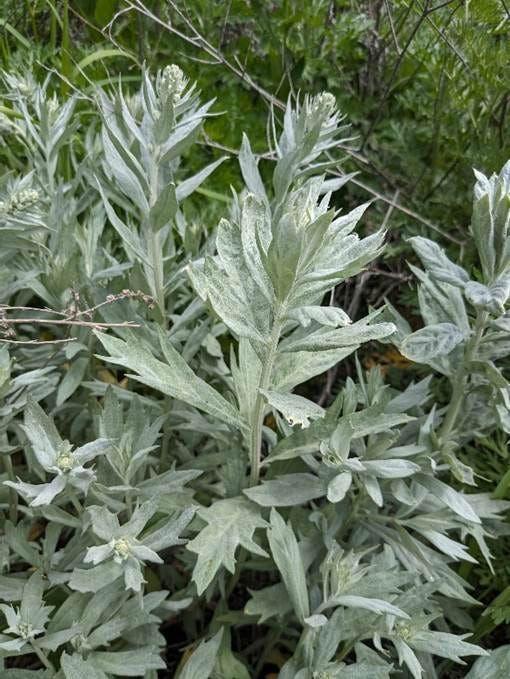
Western Mugwort, Just getting ready to bloom
Fresh plant tincture, tea, vinegar, steam and smudge are all ways to use this medicine for cold and flu. I also use it in infused oil for pain relief and in foot baths, it is great for tired achy feet. It grows wild in the mountains and along roads from the Cascades eastward. It is easy to find with its silver foliage and delightful scent. You can buy seeds at Strictly Medicinal Seeds. Plants and root stock can easily be found by local Native Plant organizations.
*This plant is not to be used during pregnancy
*Mugwort- Artemisia lud.
Tincture
Fresh tops 1:2 50% alcohol
Dry tops 1:5 50% alcohol
Drop Dose 1 to 5 drops as needed
I would use this as a drop dose for dyspepsia, after a fatty or disagreeable meal
Material doses 30 to 60 drops 2 to 3 times a day
Vinegar I just make a simple of this
Dried tops cover with apple cider vinegar.
Drop dose 1 to 5 drops
Material dose 30 to 60 drops 2 to 3 times a day.
Tea is traditional. 4 to 6 oz 2 to 3 times a day.
Cold infusion is for gastrointestinal support, and is diuretic (increases urine production)
Drunk Hot, it is a diaphoretic (opens the pores to help you sweat, thus cooling down the body and reducing fever)
Vinegar- can be taken internally for gastric issues, and topically can be applied to the forehead for headaches. [ I have used this topically on the back, of young and very healthy people to help with the lungs during infection. This is not a treatment for feeble, old, worn out, or the very young. It is too harsh]
Kane writes-
“Underlying Mugworts bitter tonic activity is a seemingly paradoxical cytoprotective effect on gastric and intestinal tissue. The plant has the ability of stabilizing cellular membrane, ultimately protecting gastrointestinal tissues from an array of inflammatory conditions. Most Artemisias have been shown to provide cyclooxygenase inhibition, increased glycoprotein, (mucus) synthesis, granulocyte degranulation inhibition, as well as a transcription factor NF-kB inhibition. All of these activities protect gastrointestinal tract mucosa from the body’s own inflammatory responses. “
Cyclooxygenase (COX 1 and 2) are responsible for blood clotting mechanisms and producing prostaglandin (a lipid). They produce pro inflammatory and anti-inflammatory responses in the body. they can create cytokines that can contribute to pain, inflammation and fever. Prostaglandin is also released when cells are damaged. [Point of interest, COX is also the pathway that interacts with NSAIDS. (ibuprofen, naproxen, and aspirin) Notice our friend Mugwort, being a multifaceted plant medicine, is also protective of the digestive tract, plants are amazing…]
The NF-kB is another cytokine. It can also signal other cytokines to be released. (including COX2) Buhner feels this is one of the cytokines to inhibit so that we can protect the lungs and reduce disease severity. A few other plants that are inhibitors of NF-kB are Chinese Senega Root, Baikal Skullcap, Ginger, Houttuynia, Kudzu, Licorice, Boneset, Astragalus. I have already written about many of these in our Antiviral Blend. There are many other plants and cytokine pathways he talks about specifically.
Steam- a pot on the stove with some simmering herb can be a nice preventative and wonderful aroma for the household. To do a steam for oneself for cold and flu, we simmer the pot, with a good handful of herbs, and pull off the heat to let it cool a little. Place a towel over your head and the pot, breathing in the warm steam. When we inhale like this the essential oils are expelled back out through the lungs and the urinary tract, clearing infection and mucus.
We see steam in traditional use in the Sweat lodge, Temazcal (and sauna) use, with water, fire, steam, and plants helping to clear toxins out of the body. We add prayer, and ceremony, treating the whole mind, body, and spirit of the individual.
Baths- Mugwort is traditionally used in Korean baths, and in the Americas for treating aches and pains, sprains, bruises and arthritis.
Smudge- To smudge a plant is to burn it, and use its smoke to clear the air, physically, and energetically. Moxa, used in TMC, is little cones of Mugwort, processed and aged, that are lit on fire(with a guard in between this cone and the body) on certain acupuncture points on the body and left to “smoke”. This helps move stuck meridians, and helps the body heal. (I make an infused oil out of fresh plant and use it for stuck pain) I use Mugwort for many other things.
I have tried to include in this writing the way Mugwort helps support the body with cold and flu. We want to keep in mind when talking about this plant, the 1918 flu pandemic, and the cytokine storm issues that resulted in younger healthy people dying. It seems relevant that Mugwort could have had a significant part in the inflammatory regulation and blood mediation response of the body, in this historic H1N1 strain.
If you have questions, comments or personal experiences please leave them below.
The information shared in these writings are for enrichment and educational purposes only. As always seek your personal health care provider in implementing any such information. Any application of this material made by the readers discretion is the readers sole responsibility.
References
Buhner, Stephen Harrod. Herbal Antivirals. North Adams MA: Storey Publishing, 2013.
Chanchal Cabrera MSc, FNIMH, RH(AHG). Holistic Cancer Care. North Adams MA: Storey Publishing, 2023.
Kane, Charles W. Herbal Medicine trends and traditions. Lincoln Town Press, 2009.
Moore, Michael. Medicinal Plants of the Mountain West. Santa Fe NM: Museum of New Mexico Press, 2003.
https://pubmed.ncbi.nlm.nih.gov/14529398/
https://pmc.ncbi.nlm.nih.gov/articles/PMC3081099/